- comparison
- robin
- pricing
- desk booking
- hybrid office
Desk & Park vs Robin: published price vs enterprise quote
Robin prices on request for larger enterprises; Desk & Park lists its price. TCO for 100 spaces, EU data, SSO, parking and setup time compared.
Robin and Desk & Park both let employees book desks, meeting rooms and parking on an office map, but they are built for different buyers. Robin publishes no price: its pricing page asks for your headcount and a call, bills every subscription annually, and says the platform is designed for companies with 500 employees or more (robinpowered.com, October 2026). Desk & Park publishes its price list: 100 desks, parking spots and rooms fit the Pro plan at 2,300 USD a year, with unlimited users, a free plan for up to 10 objects and a self-serve setup that takes 60–90 minutes for one office.
Hybrid work in 2026 follows a pattern most workplace teams recognise: Tuesday to Thursday the office is full and people circle the car park, Monday and Friday whole rows of desks stay empty. Both products exist to manage that swing.
Robin calls itself a "One Workplace Platform": desk, room, parking and locker booking, visitor management with badge printing, meeting services such as catering and AV requests, analytics, and access-control and sensor integrations; its blog announces it was named a Leader in Gartner's Magic Quadrant for Workplace Experience Applications. Desk & Park is narrower on purpose: desks, parking (with EV charger spots) and rooms on one map, QR check-in with automatic release, and board reports, at a price you can read before talking to anyone.
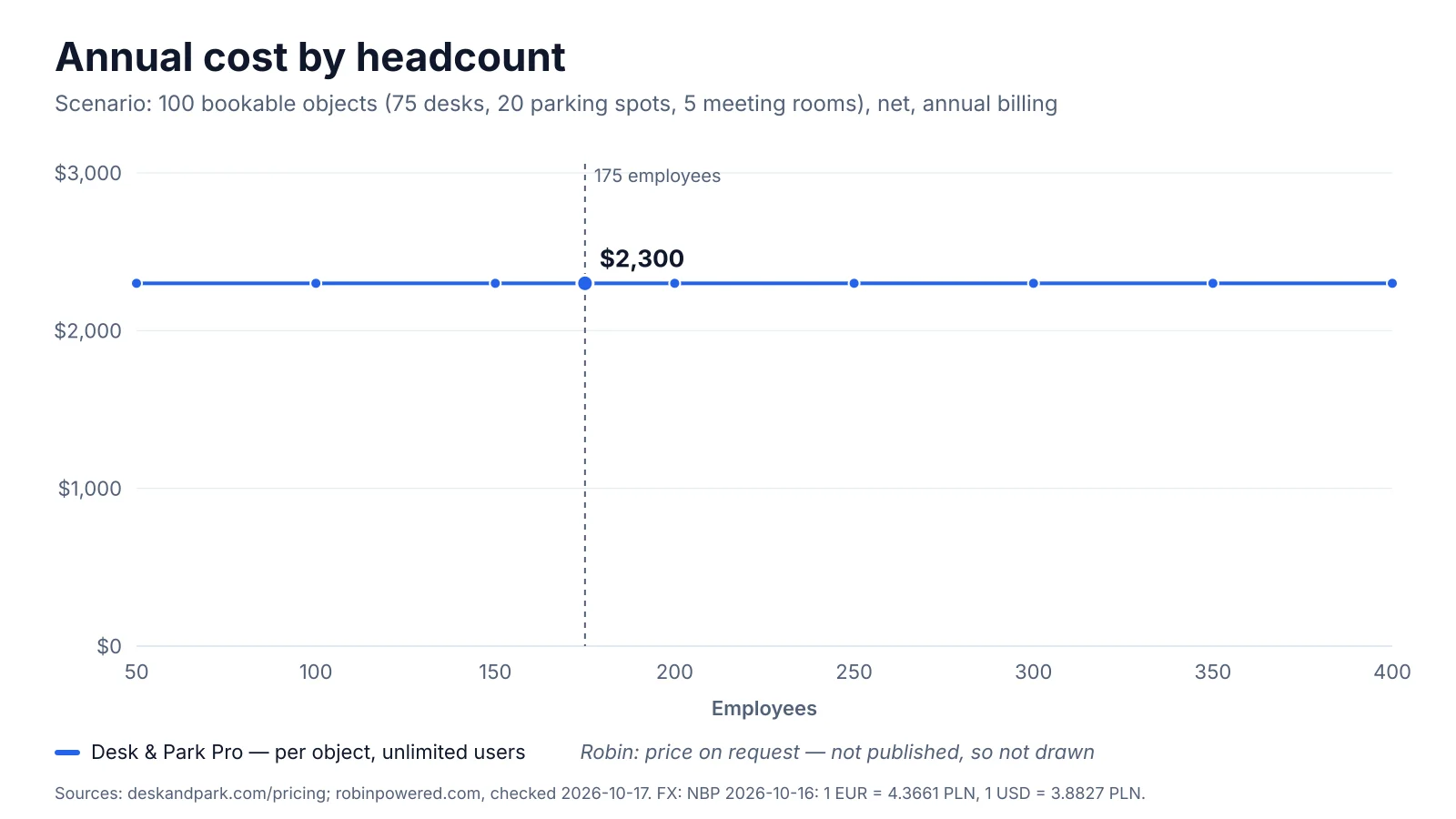
Desk & Park Pro stays at 2,300 USD a year for 100 objects whatever the headcount. Robin does not publish a price or a pricing unit, so there is no Robin line to draw; its quote form asks for global headcount (robinpowered.com/pricing, October 2026).
Pricing and total cost of ownership
Take a typical mid-sized hybrid office: 175 employees, 75 desks, 20 parking spots (4 of them with EV chargers) and 5 meeting rooms — 100 bookable objects in total.
Robin. The pricing page has no plans and no figures. It says: "Every workplace is different, so we start by getting to know yours. Complete the form to speak with our team and receive pricing tailored to your organization." What the page does publish:
- Quote only. The form asks for global headcount in bands (1–199, 200–499, 500–999, 1000–4999, 5000+). The page does not say whether the price is per user, per space or per site.
- Annual billing. "All Robin subscriptions are billed on an annual basis."
- Hardware separate. "All hardware is sold separately", through equipment partners.
- Add-ons. The Analytics AI assistant and custom reports are marked "included with optional add-on".
- Who it is for. "Robin's platform is designed for companies with 500 employees or more, with at least a third of those using the office regularly", under the heading "You have more than 150 hybrid employees using an office". Special pricing exists for universities.
So for our scenario we cannot compute a Robin figure, and we will not guess one. Ask Robin for a written quote for exactly this scenario, including add-ons and any implementation fee.
Desk & Park. 100 objects fit the Pro plan (up to 125 objects, 10 locations): 2,300 USD per year with annual billing, or 230 USD per month (2,760 USD a year). Users are unlimited, parking and EV spots are objects like any desk, there is no fee for floor plans or setup, and the room tablet needs no extra licence. Prices are net and in USD, so no currency conversion is involved.
| Scenario: 100 bookable objects, 175 employees | Per year |
|---|---|
| Robin | Not published; quote on request, billed annually |
| Desk & Park Pro, annual billing | 2,300 USD |
| Desk & Park Pro, monthly billing (12 × 230) | 2,760 USD |
Why the pricing unit matters when you grow. Desk & Park charges for objects, not people. If the company grows from 175 to 250 employees and keeps the same 100 objects, the bill stays at 2,300 USD a year; it changes only when the office does (above 125 objects, an Enterprise contract). Robin's form uses headcount bands, and 250 people sit in a different band from 175. Only Robin can say whether that changes the quote, so ask in your RFP: "What happens to the price when headcount grows by 40 % and the desks stay the same?"
Architecture, security and data protection
Desk & Park. Every customer organisation gets its own PostgreSQL database: no tables shared with other customers, backups and erasure per organisation, and an incident in one database does not touch another (why we built it this way). Databases run in Frankfurt and the application in the Netherlands, so data stays in the EU. Backups are encrypted nightly, and an audit log records who did what. Every user can sign in with two-factor authentication (TOTP), passkeys (WebAuthn) or a one-time e-mail code. Single sign-on uses OpenID Connect (Microsoft Entra ID, Google Workspace, Okta and other OIDC providers), with SCIM provisioning and deprovisioning (Entra ID, Okta), on every plan, including the free one. Data export and deletion requests are in the settings, and a data processing agreement is published.
The honest gaps: Desk & Park supports no SAML (OIDC only), and ISO 27001 and SOC 2 are planned, not certified. If your security questionnaire requires an audit report today, that is a real limitation.
Robin. Its security page (robinpowered.com/platform/security, October 2026) states that Robin runs on Amazon Web Services and that customers choose a U.S. or a European data center; application servers and data storage sit in the chosen region, while a CDN serves static assets worldwide. Data is encrypted in transit (TLS 1.2+) and at rest, backups are kept for 30 days, and third-party penetration tests run annually. Robin supports SSO through SAML 2.0, Google SSO and ADFS, with JIT provisioning and SCIM 2.0; activity logs can be downloaded from the admin portal. A July 2022 post on Robin's blog announces a SOC 2 report and states that Robin also holds ISO 27001; documentation sits in its Trust Center. The pages we checked do not say whether SSO and SCIM come at every price point (there are no public plans) or whether customers share a database; ask in writing if either matters.
On certifications and SAML Robin is ahead today. On per-customer database isolation only Desk & Park publishes an answer; EU hosting is a choice at Robin and the only option at Desk & Park.
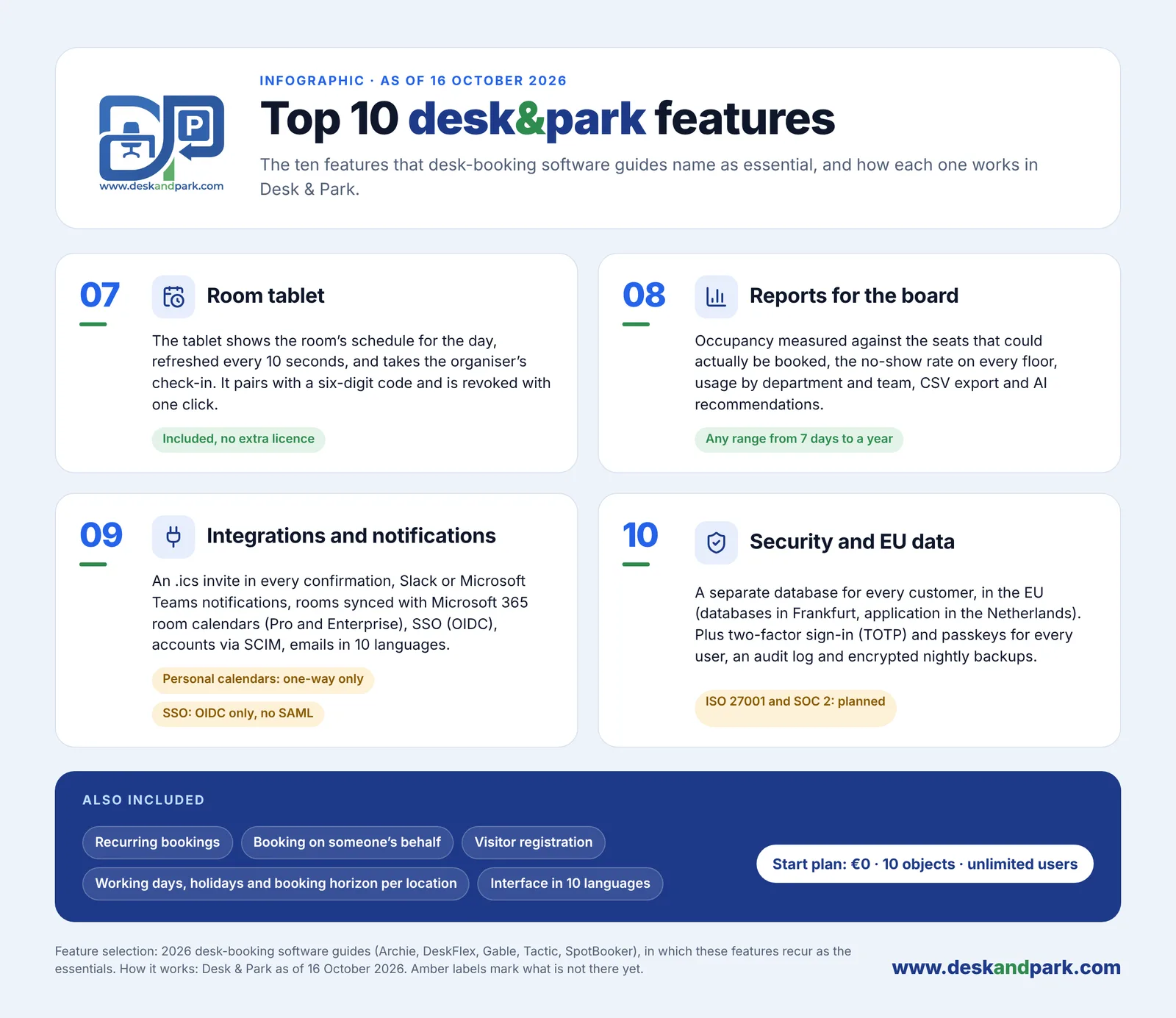
Features 07–10 of the Top 10 Desk & Park features: the room tablet, reports, integrations and EU data protection, included in the plan price rather than sold as modules.
Employee experience and team coordination
Desk & Park runs in any browser and installs as a PWA, with nothing to download from a store; an Android app adds a native QR scanner, fingerprint or face unlock and push notifications. The iOS app is planned for 2027. Scanning the QR sticker of a free desk books it and checks you in with one tap.
"Who's in the office" shows each booked person's photo or initials ringed in their team colour, with a green dot once they have checked in, and today's roster grouped by team. The company can switch it off and anyone can hide themselves, enforced on the server. Parking has its own maps (garage and surface lot, for example), EV charger spots are marked ⚡, and a desk and a parking spot booked together arrive as one calendar invitation. Board members keep assigned spaces and hand them back for the day with "I'm away today" (feature 06 of the Top 10). Interface and e-mails come in 10 languages, including Polish, Romanian, Bulgarian and Chinese.
Robin offers a free mobile app for iOS and Android, a separate admin app, a meeting room display app for iPad, Kindle Fire and Android tablets, and a visitor arrival display for iPad. Its platform page lists booking of desks, rooms, parking and lockers "with AI-powered recommendations", automatic desk booking based on past bookings, a live map to find coworkers, and check-in through Wi-Fi, badges, QR codes or NFC. Employees can also book from Outlook, Microsoft Teams, Slack and Google. Its January 2026 release notes mention limiting EV charging spots to authorised employees. Robin's help centre lists seven interface languages: English, French, Canadian French, German, Spanish, Italian and Japanese.
Both cover the core: find a desk on a map, see your team, check in. Robin is broader in channels (iOS today, an Outlook add-in, badge and Wi-Fi check-in). Desk & Park keeps parking, EV spots and rooms on every plan, needs no install, and covers languages Robin does not list.
Space optimisation, reports and AI
The quiet cost of hybrid work is the ghost booking: a desk or parking spot reserved and never used. In Desk & Park, a desk or parking booking not checked in by your organisation's deadline (for example "check in by 10:00") returns to the pool automatically (how auto-release works). Meeting rooms are released only if the organisation turns that on (off by default, after 5 to 120 minutes without a check-in); scanning the QR code of a free room books the next half hour.
Board Reports measure occupancy against the seats that could actually be booked, the no-show (ghost) rate per floor and resource, usage by department and team, EV charging demand and the peak day, for any range from 7 days to a year, with CSV export. AI recommendations work like this: an administrator clicks "Generate report", a large language model receives aggregates only (no employee names) and returns 3–6 recommendations in categories such as cost saving, space consolidation, EV optimisation, ghost booking alerts, board member impact, ESG and capacity planning, each with a model-written impact estimate. The board triages them with Dismiss or Mark as done, recorded in the audit log. This is not predictive forecasting, and Desk & Park does not calculate savings or costs: the impact estimate is the model's hypothesis to verify.
Robin says its real-time availability monitoring "automatically releases space when no-shows occur". Its analytics cover office usage insights, sensor and access-control data and exports; custom reports and an Analytics AI assistant come with an optional add-on. The platform page also mentions "AI insights for space usage analysis and capacity forecasting", scenario planning, move management and CAD imports of floor plans. For a real-estate team planning a multi-building portfolio, that is a deeper planning toolset than Desk & Park offers.
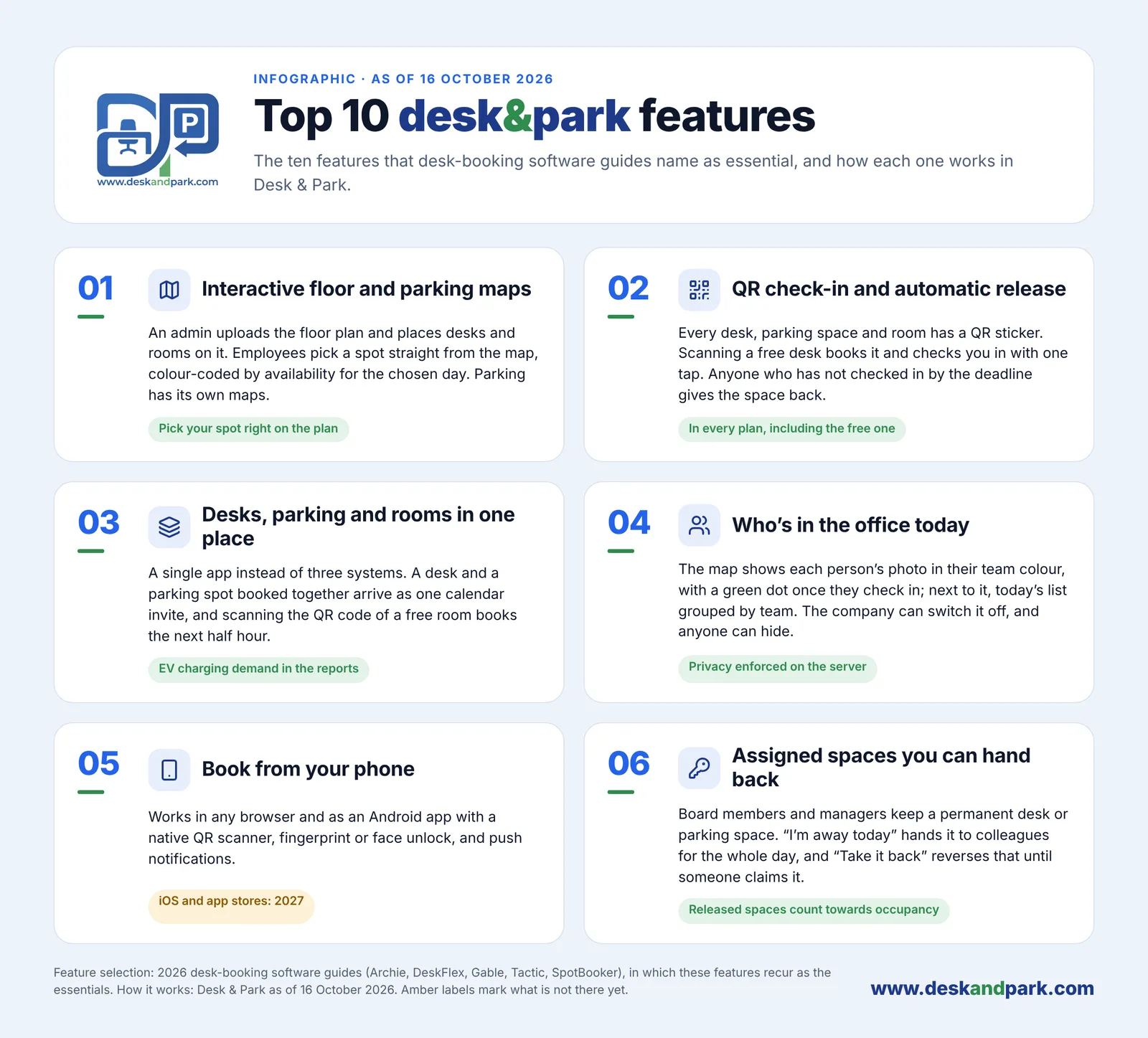
Features 01–06 of the Top 10: the everyday part — map, QR check-in with auto release, desks, parking and rooms in one app, who's in the office, phone booking and assigned spaces you can hand back.
Side-by-side comparison
| Desk & Park | Robin | |
|---|---|---|
| What it is | Booking for your own offices: desks, parking, EV spots, rooms | Workplace platform: booking, visitors, deliveries, meeting services, analytics, space planning |
| Stated target | Any office size; free plan up to 10 objects | "Designed for companies with 500 employees or more" |
| Pricing unit | Plan by number of bookable objects; unlimited users | Not published; quote form asks for global headcount |
| Entry price | Start: 0 USD, up to 10 objects, 1 location | Not published; annual billing only |
| Scenario TCO (100 objects, 175 people) | 2,300 USD/year (Pro, annual billing) | Quote on request |
| Setup fees and time | No fees; self-serve, 60–90 minutes for one office | Not published; hardware sold separately |
| Parking and EV | On every plan; separate parking maps; EV spots marked ⚡ | Parking and lockers bookable; EV spots can be limited to authorised staff |
| Data isolation | Own PostgreSQL database per organisation | Not published |
| Hosting region | EU: Frankfurt (databases), Netherlands (application) | AWS; customer chooses U.S. or European data center |
| Certifications | ISO 27001 and SOC 2 planned, not certified | SOC 2 and ISO 27001 (announced on Robin's blog, 2022) |
| SSO and provisioning | OIDC and SCIM on every plan; no SAML | SAML 2.0, Google SSO, ADFS, JIT, SCIM 2.0; plan coverage not published |
| Mobile apps | Browser/PWA and Android; iOS in 2027 | iOS and Android apps, plus admin and display apps |
| QR check-in and auto-release | Yes, deadline set per organisation | Check-in by Wi-Fi, badge, QR or NFC; auto-release of no-shows |
| Room tablet | Included, no extra licence | Room display app for iPad and Android tablets; hardware separate |
| Reports and AI | Board Reports; AI recommendations from aggregates | Analytics; AI assistant and custom reports as add-on |
| Languages | Interface and e-mails in 10 languages | 7 listed (EN, FR, FR-CA, DE, ES, IT, JA) |
Robin facts from robinpowered.com (pricing, platform, security and blog pages) and support.robinpowered.com, checked October 2026; prices and features change — check the current page.
Verdict: which one fits your company
Robin is the better fit if you are a large enterprise — the 500-plus employees its own page describes — with several buildings or campuses, and want one vendor for booking, visitors with badge printing, deliveries, catering and AV requests, sensor and access-control data, and space and move planning. It also fits a security review that needs SAML, ADFS or a SOC 2 report today, U.S. data residency, an iOS app from day one or an Outlook add-in.
Desk & Park is the better fit if you are a mid-sized organisation that wants a price on the page (100 objects: 2,300 USD a year) rather than a sales cycle, parking and EV spots on the same map as desks on every plan, data in the EU in a database of its own, and one administrator who can set it up in an afternoon. It also fits teams working in Polish, Romanian, Bulgarian or Chinese.
See the pricing, the desk booking and parking booking pages, the Top 10 Desk & Park features, and for background the corporate parking management guide.
FAQ
How much does Robin cost compared with Desk & Park?
Robin does not publish prices: its pricing page asks for your headcount and a call, and all subscriptions are billed annually (robinpowered.com, October 2026). Desk & Park publishes its plans: 100 desks, parking spots and rooms fit Pro at 2,300 USD a year with annual billing, with unlimited users. Ask Robin for a written quote for the same scenario to compare.
Is Robin designed for small and mid-sized companies?
Robin's pricing page says its platform is designed for companies with 500 employees or more, with at least a third using the office regularly. Desk & Park has no minimum size: the Start plan is free for up to 10 objects, and 100 objects cost 2,300 USD a year regardless of headcount.
Which one supports SAML and has SOC 2?
Robin supports SSO through SAML 2.0, Google SSO and ADFS, plus SCIM 2.0, and its blog announced SOC 2 and ISO 27001 in July 2022. Desk & Park supports OpenID Connect and SCIM on every plan, including the free one, but no SAML, and its ISO 27001 and SOC 2 certifications are planned, not completed.
How long does setup take?
Desk & Park's onboarding guide quotes 60–90 minutes for one office: one administrator, six self-serve steps, no implementation call. Robin does not publish an implementation timeline or fee; its pricing page routes buyers to a demo and notes that hardware is sold separately.
#DeskAndPark#Comparison#Robin#Pricing#DeskBooking#HybridOffice
Ask AI about this article
Get a summary or a second opinion: each button opens the assistant with a question about this article.