- comparison
- parkalot
- parking management
- desk booking
- hybrid office
- pricing
Desk & Park vs Parkalot: parking specialist or one app?
Parkalot is parking-first, from $49/month; Desk & Park books desks, parking and rooms per object. TCO for 100 spaces, fairness rules, SSO and EU data.
Parkalot and Desk & Park both price by the number of spaces, not by headcount, so the real difference is depth, not cost. Parkalot is a parking-first tool (from $49 per month for up to 15 spaces, $199 per month for up to 100, per parkalot.io in October 2026) with waitlists, priority rules, native iOS and Android apps, SAML and an API for number-plate cameras and barriers. Desk & Park books desks, parking spots and meeting rooms on one map for 2,300 USD per year for up to 125 objects. It keeps each customer in its own PostgreSQL database in the EU and includes SSO and SCIM on every plan, the free one included.
Hybrid offices in 2026 follow a familiar rhythm: full from Tuesday to Thursday, half empty on Monday and Friday. Parking is where that hurts most, because a full car park has no overflow. Parkalot, based in Kraków, Poland, was built for that problem: it promises to make workplace car parking "fair, easy and frustration-free" and now also books desks, meeting rooms and EV chargers. Desk & Park started from the other end, a hybrid-office booking tool in which parking and EV charger spots are first-class objects next to desks and rooms.
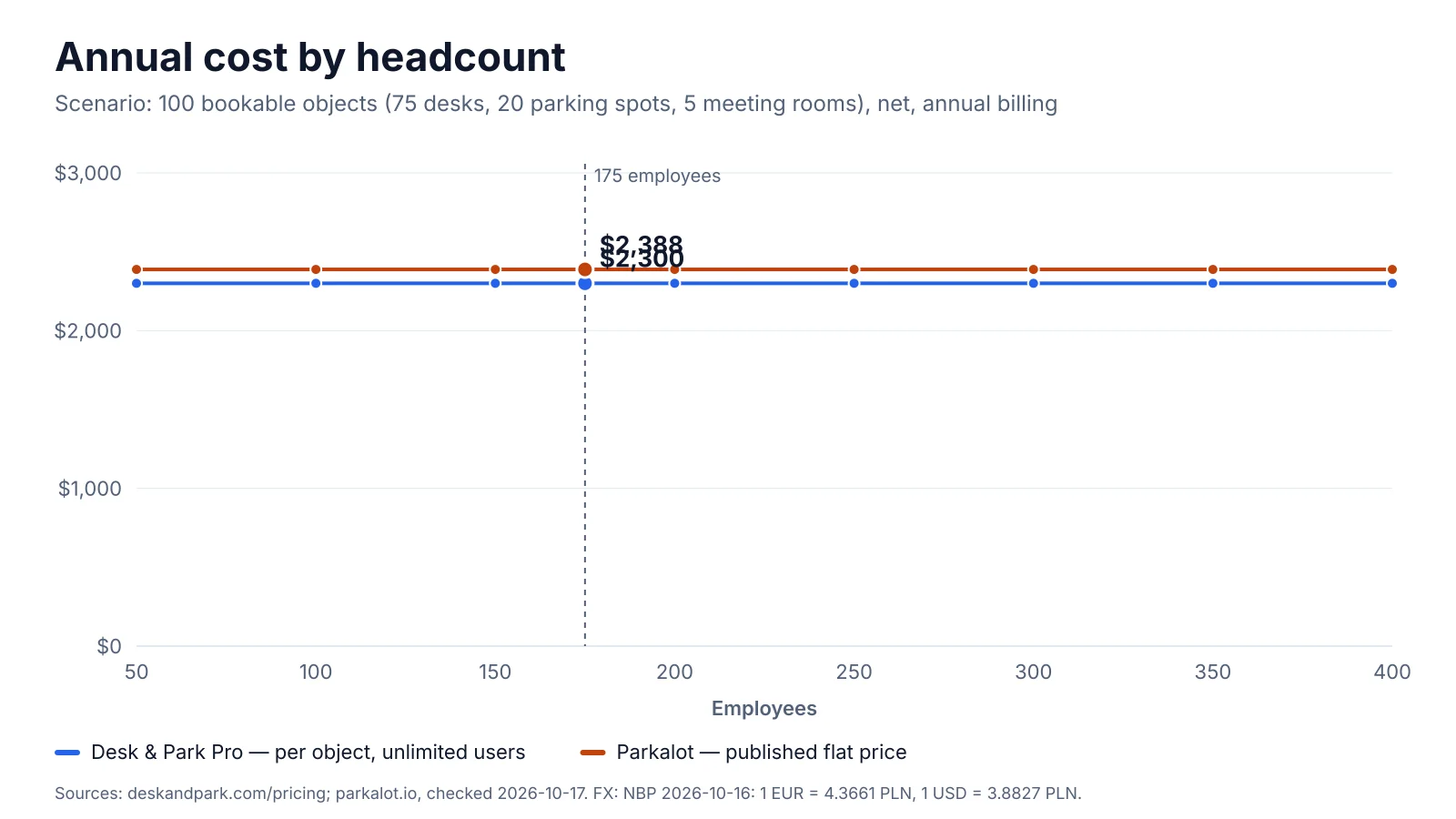
Both vendors charge by space count with unlimited users (Parkalot from its Medium plan), so neither line rises with headcount. Parkalot: $199/month Large plan, as published on parkalot.io in October 2026.
Pricing and total cost of ownership
Parkalot publishes four plans. Small costs $49 per month for up to 15 spaces and 50 users. Medium costs $99 per month for up to 40 spaces with unlimited users and admins. Large costs $199 per month for up to 100 spaces, with unlimited users and priority support. Enterprise is priced on quote, for larger car parks and multi-site deployments. The pricing page calls the unit "parking spaces"; the features table calls it "bookable spaces" and lists desks and rooms among them. VAT and annual terms are not stated. There is a 30-day free trial without a credit card and, per the FAQ, no implementation or onboarding fee.
Desk & Park also prices per bookable object (desk, parking spot, EV charger spot, meeting room), with unlimited users on every plan. Start is free for up to 10 objects, Standard costs 128 USD per month for up to 75, Pro costs 230 USD per month for up to 125, and Enterprise is custom. Annual billing is ten times the monthly price. There is no fee for floor plans and no implementation project.
The scenario: 175 employees, 75 desks, 20 parking spots (4 with EV chargers) and 5 meeting rooms, which is 100 bookable objects.
| Desk & Park | Parkalot | |
|---|---|---|
| Plan that fits | Pro (up to 125 objects) | Large (up to 100 spaces), assuming desks and rooms count towards the limit |
| Published price | 230 USD/month, or 2,300 USD/year billed annually | $199/month |
| Year 1 | 2,300 USD (annual) or 2,760 USD (monthly) | 12 × 199 = 2,388 USD |
| One-off fees | None | None (setup included) |
With annual billing, Desk & Park costs 88 USD less per year (3.7 %). Month to month, Parkalot is cheaper: 199 versus 230 USD, or 372 USD less over a year, so Desk & Park costs 15.6 % more. For this office the two cost about the same.
Two structural points matter more than that gap:
- Headroom. The scenario fills Parkalot's Large plan exactly. One more meeting room or a second car park area takes the company past 100 spaces and into an Enterprise quote. Desk & Park Pro covers up to 125 objects and 10 locations at the same price.
- Headcount. If the company grows from 175 to 250 people, neither bill changes: both vendors offer unlimited users (Parkalot from Medium; Small is capped at 50 users).
If you only need parking, the result flips. For the 20 parking spots alone, Parkalot Medium costs 12 × 99 = 1,188 USD per year and Desk & Park Standard 1,280 USD billed annually, so Parkalot is 92 USD cheaper. A car park of up to 10 spots fits Desk & Park's free Start plan; Parkalot has no free plan, only the trial.
Architecture, security and data
Desk & Park gives each customer organisation its own PostgreSQL database. Its data shares no tables with other customers, backups and erasure work per organisation, and an incident in one database does not touch another. Databases are hosted in Frankfurt and the application runs in the Netherlands. Backups are encrypted nightly, and an audit log records who did what. Users sign in with a one-time e-mail code and can add two-factor authentication (TOTP) or a passkey (WebAuthn). Single sign-on via OpenID Connect (Microsoft Entra ID, Google Workspace, Okta and other OIDC providers) and SCIM provisioning come with every plan, including the free one. Data export and deletion requests are in the settings, and a DPA is published. The gaps, stated plainly: Desk & Park supports OIDC only, not SAML, and ISO 27001 and SOC 2 are planned, not yet certified.
Parkalot, per its website in October 2026:
- Hosting: its software page says it runs on Google Cloud, which holds ISO 27001 and SOC 2. Its app privacy policy names Google (main locations EU/Ireland and USA) and AWS (EU and USA) as subprocessors, and says personal data may be transferred outside the EEA, including to the US, under safeguards such as Standard Contractual Clauses.
- Certification: its homepage displays an ISO 27001 certificate badge, and its comparison pages describe Parkalot as ISO 27001 compliant. If this matters to your review, ask for the certificate and its scope.
- Identity: SSO with Microsoft Entra ID, Google Workspace and SAML 2.0 providers such as Okta and PingID, SCIM provisioning (with an Azure Marketplace listing) and enforced SSO login. The site does not state which plans include SSO.
- Controls: it describes itself as GDPR-compliant and lists tiered admin roles, group-based restrictions, reservation privacy controls and password policies. It does not publish its tenancy model.
If your identity team requires SAML, or procurement needs an ISO 27001 certificate today, Parkalot meets that and Desk & Park does not yet. If you need named EU locations and per-customer database isolation, Desk & Park documents both.
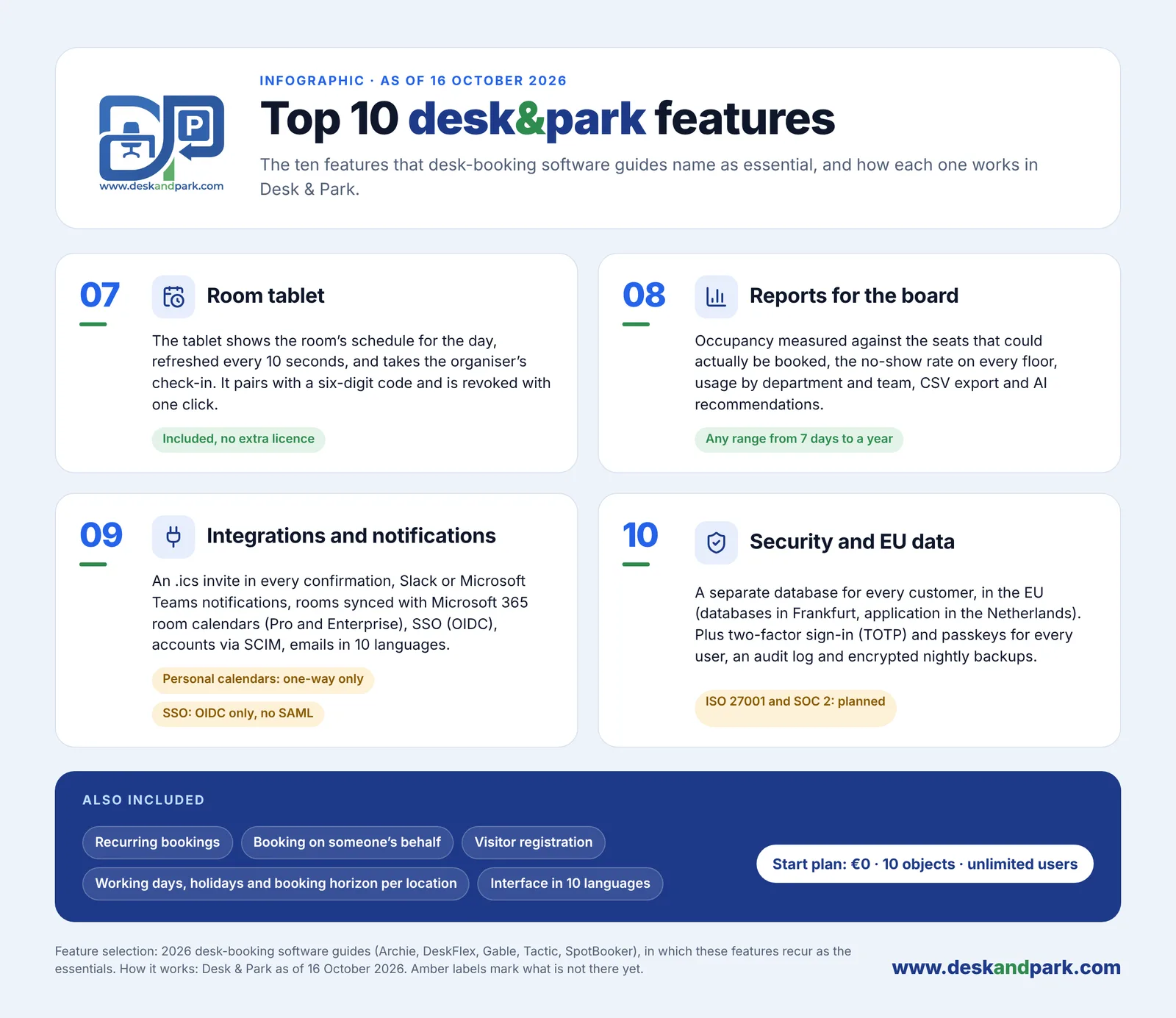
Features 07–10 of the Top 10 Desk & Park features: the room tablet, reports, integrations and security with EU data, included on every plan.
Employee experience and team coordination
Apps. Parkalot has native iOS and Android apps and a web app that needs no installation. Desk & Park runs in any browser and installs as a PWA. Its Android app adds a native QR scanner, fingerprint or face unlock and push notifications. The iOS app is planned for 2027, so if you need native apps on both platforms today, Parkalot has them.
Parking rules: where Parkalot goes deeper. This is Parkalot's home ground, and its published list is longer:
- a waitlist, also per area, that assigns a released space to the next person "based on a fair algorithm";
- priority rules between employees and groups, reservation time blocking (booking opens at different times for different groups) and group-based access restrictions;
- part-of-day bookings (shifts, hours, quarters) and a booking window from the day before up to a month ahead;
- permanent space ownership with an optional confirmation deadline: an owner who does not confirm loses the space to the pool automatically;
- visitor parking zones with arrival instructions by e-mail, tandem parking coordination by chat, and incident reports;
- hardware integration through its open API: ANPR (number-plate recognition) cameras, badge readers and barriers, set up case by case.
Desk & Park's parking model is simpler by design. Every spot is a pin on a parking map, with several areas per location (a garage and a lot, for example), booked for the day like a desk. By default each person books one spot per day; executive assistants are exempt so they can book for guests. Board members (and managers on Enterprise) keep assigned spots, release them with I'm away today and can Take back until someone claims them. There is no automatic release of permanent spaces after a missed scan, no waitlist, no lottery and no licence-plate or barrier integration. If a contested car park needs a queue or automatic rotation, Parkalot offers more.
Where one app helps. For the employee, "coming in on Thursday" is one decision. In Desk & Park a desk and a parking spot booked together arrive as one calendar invitation. EV charger spots carry a ⚡ on the map; anyone can book them, and the house rule decides who should. Who's in the office shows each booked person's photo or initials in their team colour, with a green dot after check-in; the company can switch it off and anyone can hide themselves. Parkalot also books desks and rooms and adds work-mode reporting (remote, sick leave). Desk & Park comes in 10 languages; Parkalot lists six. More in our guide to corporate parking management.
Space optimisation and AI
A booked spot that nobody uses is the expensive kind of empty. Both tools fight ghost bookings with check-in:
- Desk & Park: every desk, parking spot and room has a QR sticker. Scanning a free desk or spot books it and checks you in with one tap. A desk or parking booking not checked in by the organisation's deadline (for example "check in by 10:00") returns to the pool automatically. Meeting rooms are released only if the organisation turns that on (off by default, after 5 to 120 minutes without a check-in); scanning a free room books the next half hour.
- Parkalot: reservation confirmation requires users to check in within a set timeframe, no-show reports track the rate, and the waitlist passes released spaces on.
Reporting. Parkalot lists 11 types of downloadable reports (occupancy by weekday and group, waitlist activity, no-shows, work modes), CSV and API export for Power BI. Desk & Park's Board Reports measure occupancy against the seats that could actually be booked. They show the ghost rate per floor and resource, usage by department and team, EV charging demand and the peak day, with CSV export for any range from 7 days to a year. See EV charging spots: mark them, book them, measure demand.
AI recommendations (feature 08 of the Top 10). An admin clicks "Generate report", and a large language model receives aggregates only, with no employee names. It returns 3–6 recommendations (cost saving, EV optimisation, ghost-booking alerts and more), each with an impact estimate written by the model, which the board dismisses or marks done. This is not predictive machine learning or occupancy forecasting, and Desk & Park does not calculate savings; the estimate is a hypothesis to verify. Parkalot does not publish a comparable AI feature.
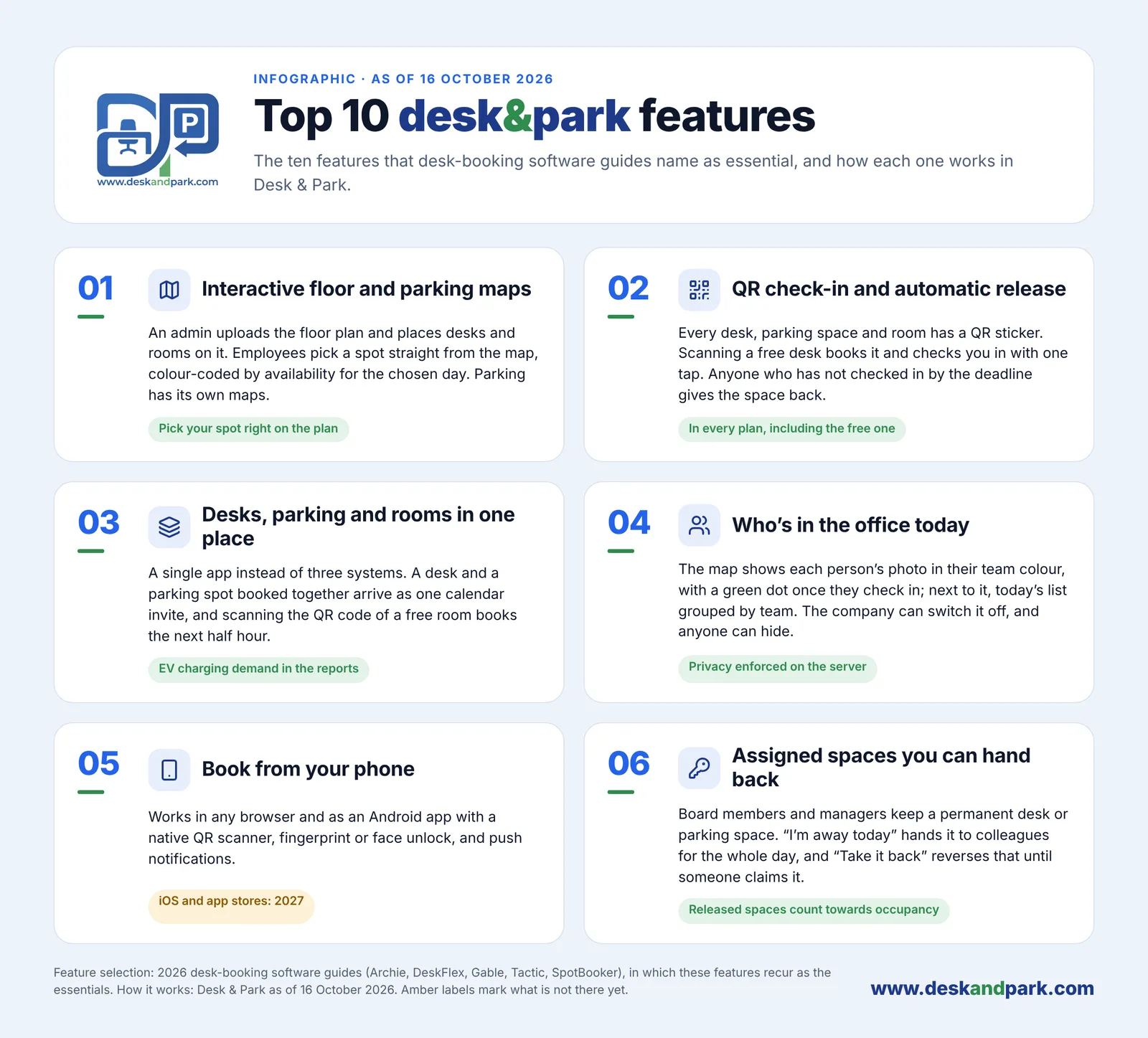
Features 01–06 of the Top 10: the everyday side of Desk & Park, the same on every plan.
Side-by-side comparison
| Desk & Park | Parkalot | |
|---|---|---|
| Pricing unit | Per bookable object; unlimited users on every plan | Per number of spaces; unlimited users from Medium |
| Entry price | Start: 0 USD, up to 10 objects | Small: $49/month, 15 spaces, 50 users; 30-day trial |
| Scenario TCO (100 objects, year 1) | 2,300 USD (Pro, annual) | 2,388 USD (Large, 12 × $199) |
| Setup / one-off fees | None; self-serve, 60–90 min for one office | None; 30 min for small companies, typically within 72 hours |
| Data isolation | One PostgreSQL database per organisation | Not published |
| Hosting | EU: Frankfurt (databases), Netherlands (app) | Google Cloud; subprocessors in EU and USA |
| SSO / provisioning | OIDC + SCIM on every plan; no SAML | Microsoft, Google, SAML 2.0; SCIM |
| Certifications | ISO 27001 / SOC 2 planned | ISO 27001 badge on homepage |
| Mobile apps | Web/PWA, Android; iOS in 2027 | Native iOS and Android, web app |
| Parking fairness | One spot per person per day, manual release of assigned spots | Waitlist, priority groups, time blocking, auto-release of unconfirmed owners |
| ANPR / barriers | No | Via open API, case by case |
| EV chargers | ⚡ spots on the map, EV demand in reports | EV chargers as a space type |
| QR check-in and auto-release | Yes, desks and parking | Check-in within a set timeframe |
| Room tablet | Included, no extra licence | Not published |
| Reports / AI | Board Reports, CSV, AI recommendations | 11 report types, CSV, API / Power BI |
| Languages | 10 | 6 |
Competitor facts from parkalot.io, checked October 2026; prices and features change, so check the current page.
Verdict
Parkalot is the better fit when parking is the main problem and it is contested: a large car park where demand regularly exceeds supply, where you want a waitlist, priority groups and part-of-day slots. It also wins if you want ANPR cameras or barriers tied to bookings, your identity team mandates SAML, procurement asks for an ISO 27001 certificate today, or you need native iOS and Android apps from day one. Month to month it is slightly cheaper for 100 spaces, and cheaper still for parking alone.
Desk & Park is the better fit when desks, parking and rooms should be one decision for the employee and one bill for the company. It suits teams that want per-customer database isolation in named EU locations, OIDC SSO and SCIM even on the free plan, and room tablets and AI recommendations in the price. It covers up to 125 objects before an enterprise conversation. Setup takes 60–90 minutes for one office, and the pricing is published to the dollar. Read why office parking is the real challenge and see the parking booking page.
FAQ
Is Desk & Park cheaper than Parkalot?
For a 100-space office they cost about the same. Desk & Park Pro costs 2,300 USD per year billed annually; Parkalot's Large plan is $199 per month, or 2,388 USD over 12 months (parkalot.io, October 2026). Month to month Parkalot is cheaper (199 versus 230 USD), and for parking alone its $99 Medium plan undercuts Desk & Park Standard.
Does Desk & Park have a parking waitlist or lottery like Parkalot?
No. Desk & Park has no waitlist and no lottery. Fairness comes from one spot per person per day, a map everyone sees, QR check-in with automatic release of no-shows, and assigned spots that holders release with "I'm away today". Parkalot publishes a waitlist that assigns released spaces with a fair algorithm, plus priority and time-blocking rules.
Can either tool open a barrier or read number plates?
Parkalot integrates ANPR cameras, badge readers and barriers through its open API, set up case by case for hardware with an internet connection. Desk & Park has no barrier or licence-plate integration: it decides who is entitled to a spot, and the existing gate or camera stays as it is.
Which one supports SAML single sign-on?
Parkalot supports SAML 2.0 providers such as Okta, as well as Microsoft and Google, plus SCIM provisioning. Desk & Park supports OpenID Connect (Entra ID, Google Workspace, Okta and other OIDC providers) and SCIM on every plan, including the free one, but not SAML.
Is there a native iPhone app?
Parkalot has native iOS and Android apps. Desk & Park works in any phone browser and installs as a PWA, and it has an Android app; its iOS app is planned for 2027.
#DeskAndPark#Comparison#Parkalot#ParkingManagement#DeskBooking#HybridOffice#Pricing
Ask AI about this article
Get a summary or a second opinion: each button opens the assistant with a question about this article.